
Why Golden Gate Venture’s MENA Fund Is Investing in AI Infrastructure

I have spent 29 years at the intersection of technology and enterprise value creation. After graduating from The Hague University in 1997 with a degree in Computer Science, I cut my teeth writing assembly code—close enough to the silicon to appreciate the essence, and the constraints, of every clock cycle. In 2000, I co-founded my first technology company. We were at the height of the dot-com bubble. The two-and-a-half decades since have taken me from low-level systems programming through enterprise software, cloud architecture, the design and deployment of data-centre capability and becoming a founding partner of Golden Gate Venture’s MENA fund.

Each technology transformation I have been a part of reinforced a crucial lesson: infrastructure precedes transformation. In the late 1990s it was the shift from mainframes to client-server architectures that unlocked a generation of enterprise software companies. In the 2000s it was broadband connectivity that turned the internet from a novelty into a commercial platform. In the 2010s it was the public cloud that democratised computing power for startups and SMEs. First-hand, I saw how each of these waves impacted the investors and builders who positioned themselves at the infrastructure layer. . Frontier technology does not trickle down; it becomes foundational for everything that is being built.
That conviction underpins Golden Gate Venture MENA fund’s investment thesis. The Gulf region—and MENA—stands at precisely such an inflection point. Artificial intelligence is not merely the next application layer; it is a new foundation for economic activity, and the infrastructure that supports it will determine which nations, enterprises, and communities capture its benefits. The parallels to earlier technology transitions are evident, but currently the scale is much larger and more impactful, sovereign capital more concentrated, and the strategic urgency more acute. This article sets out the case for institutional investors: why AI infrastructure in the MENA region represents a generational opportunity, and why GGV MENA is deploying capital behind it.
The MENA AI Infrastructure Opportunity: Scale and Velocity
The GCC AI market reached an estimated USD 11.75 billion in 2024 and is growing at a compound annual rate of 35.5 percent. The broader MENA AI market is projected to expand from USD 27.4 billion in 2024 to roughly USD 257 billion by 2032—a 32.7 percent CAGR that outpaces most comparable global segments. AI-specific data-centre capacity in the region, valued at USD 2.5 billion in 2026, is forecast to reach USD 8.2 billion by 2031, while total regional data-centre capacity is expected to triple from one gigawatt today to 3.3 gigawatts by 2030.
They projections are underwritten by sovereign capital and regional commitments. In the past 18 months alone, the UAE has announced a five-gigawatt AI campus—the largest AI infrastructure project outside the United States—and secured a guaranteed annual allocation of 500,000 top-tier Nvidia GPUs through G42. Saudi Arabia has earmarked USD 40 billion for AI technology, semiconductors, and data centres, anchored by the Public Investment Fund's USD 10 billion partnership with Google Cloud to build a global AI hub. Qatar has launched QAI, a national AI company backed by the Qatar Investment Authority, alongside a USD 20 billion joint venture with Brookfield. Microsoft has committed USD 15.2 billion to the UAE, and AWS plans to open a Saudi cloud region by 2026.
What distinguishes the Gulf's AI infrastructure push from other regional technology buildouts is the seamless coordination between state capital, regulatory design, and commercial incentives. There is not only a sense of urgency, but an understanding of the impact on the region long term. These are not disconnected public-sector projects; they are integrated industrial strategies that combine sovereign investment with private-sector partnerships, free-zone incentives, and explicit mandates for technology localisation.
For institutional investors, the signal is unambiguous: the Gulf states are converting hydrocarbon wealth into compute at a pace and scale that will reshape global AI geography. Data-centre colocation investment alone is projected at USD 33.8 billion between 2025 and 2030, representing nearly 200 percent absolute growth. The question is no longer whether this market will materialise, but how to position within it.
Sovereign AI and Data Residency: The Policy Tailwind
A defining feature of the MENA AI build-out is its intersection with data sovereignty. Each major Gulf economy has enacted or strengthened data protection and residency frameworks over the past two years. Saudi Arabia's Personal Data Protection Law is now fully enforceable. The UAE's Federal Data Protection Law 45/2021 governs both government and private-sector operations. Qatar's 2024 Central Bank Cloud Computing Regulations impose stringent residency requirements on financial institutions.
These regulatory frameworks are strategic. Gulf governments recognise that control over data flows is inseparable from economic and national security. The result is a structural demand for localised AI infrastructure—sovereign cloud regions, in-country GPU clusters, and on-premises inference capability—that cannot be satisfied by hyperscaler regions located outside the region. Microsoft, Google, Oracle, and AWS have all responded by establishing or expanding dedicated cloud regions in the Gulf, but the opportunity for specialised, regionally-anchored infrastructure providers remains vast. GGV’s MENA Fund sees this as a big opportunity.
For investors, the sovereign-AI thesis carries two important implications. First, it creates a durable demand: enterprises operating in regulated sectors—banking, healthcare, government services, energy—must process data locally regardless of cost optimisation pressures. Even if global cloud costs decline, the compliance requirement for in-country processing ensures that locally deployed infrastructure retains pricing power and utilisation rates that purely commercial demand might not sustain alone.
Second, the sovereign-AI imperative produces a structural advantage for homegrown companies that understand local regulatory nuances, possess existing government relationships, and can iterate on compliance requirements in real time. This is the environment in which GGV MENA is sourcing its most compelling opportunities—companies that can bridge the gap between global technology platforms and sovereign compliance mandates.
Enterprise and SME Transformation: Where Infrastructure Meets Impact
The macroeconomic case for AI infrastructure is compelling, but the microeconomic case is equally powerful—and it is the microeconomic case that ultimately generates the revenue streams infrastructure investors depend on. Small and medium-sized enterprises constitute approximately 90 percent of businesses across the MENA region. They are the engine of employment, diversification, and non-oil GDP growth—yet they remain disproportionately dependent on legacy systems, spreadsheet-driven operations, and manual workflows. The gap between the digital sophistication of Gulf-based multinationals and the SME base is among the widest in any major economic region—and that gap is precisely the opportunity.
AI infrastructure closes that gap—by providing accessible, affordable, and locally-compliant compute that enables AI-as-a-service delivery. Consider the trajectory: cloud and edge computing already anchor nearly 23 percent of digital-transformation revenue in the region; 39 percent of MENA enterprises report advanced use of generative AI; and the regional SME technology market is growing at 26.9 percent annually. When inference costs fall and model access is democratised through local infrastructure, the addressable market expands from early-adopter enterprises to the long tail of regional businesses.
I have built data-centre capability specifically for SMEs, and I understand the economics behind it. The unit economics of AI infrastructure improve dramatically with regional density. The key is to invest in the foundational layer—the compute, the connectivity, the compliance framework—and allow an ecosystem of application providers to build on top. This is, in many ways, the same playbook that transformed cloud computing from an enterprise feature into a utility, and it is the playbook GGV MENA is backing.
The sectors poised for the most immediate impact are financial services, energy, logistics, and government services. In financial services, local AI infrastructure enables real-time fraud detection, credit scoring, and regulatory reporting without cross-border data transfers. Digital payments already represent 20 percent of online spending in the region, and mobile commerce is projected to account for 70 percent of online transaction value—each of these transactions generating data that, under residency requirements, must be processed locally. In energy, predictive maintenance and operational optimisation powered by in-country AI can improve asset productivity across the Gulf's vast oil, gas, and renewable portfolios. In logistics, AI-driven routing, inventory management, and demand forecasting are already demonstrating measurable ROI for regional players. And in government services, sovereign AI infrastructure underpins everything from smart-city platforms to national identity systems and public-health analytics.
The Investment Thesis: Homegrown Champions and Global Entrants
GGV MENA's investment strategy rests on a fundamental observation: the MENA AI infrastructure market will be served by two categories of winners, and the most durable value creation will come from their intersection.
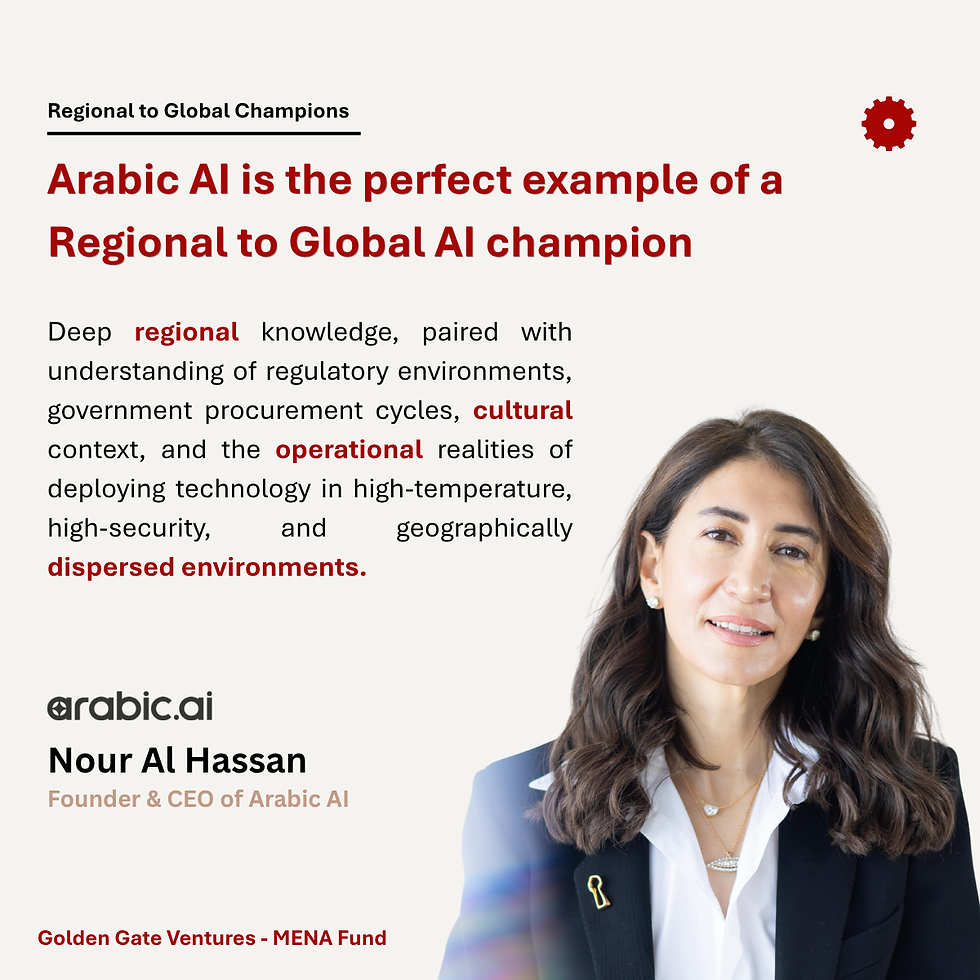
The first category is homegrown companies from the Gulf. These are businesses founded by teams with deep regional knowledge—understanding of regulatory environments, government procurement cycles, cultural context, and the operational realities of deploying technology in high-temperature, high-security, and geographically dispersed environments. Nour Al Hassan’s, Arabic AI follows exactly this narrative. They possess relationships that take years to build and local talent pipelines that international entrants cannot easily replicate.
The second category is top-tier international companies expanding into the region. The Gulf will be one of the three or four most important AI infrastructure markets globally within this decade. International tech companies bring technology, talent, and operational best practices—but they need local partners for distribution, compliance, integration, and last-mile delivery.
The intersection of these two categories—where global technology meets local execution—is where GGV MENA sees the greatest risk-adjusted returns. We are investing in companies that serve as the connective tissue between hyperscale platforms and regional demand: managed AI service providers, sovereign cloud operators, AI application platforms tailored to Arabic-language markets, and infrastructure-adjacent businesses in power, cooling, and connectivity.
Managed AI service providers in the Gulf can capture margins that are structurally higher than their counterparts in more mature markets, because the combination of regulatory complexity, language specificity, and relationship-driven procurement creates barriers to entry that pure technology advantage cannot overcome. A global hyperscaler can deploy compute, but it cannot easily navigate the procurement protocols of a Gulf sovereign wealth fund, tailor large-language-model fine-tuning for Arabic dialects, or manage the physical and regulatory realities of data-centre operations in a high-temperature, sand-intensive environment.
Risk, Timing, and Conviction
Regulatory frameworks, while maturing rapidly, remain subject to change. Talent remains scarce relative to ambition—though this is precisely why infrastructure investments that reduce the talent required per unit of AI deployment are so valuable, and why Gulf governments are investing heavily in national skilling programmes. And the sheer scale of sovereign capital can create valuation distortions that disciplined investors must navigate carefully.
But the balance of risk and opportunity tilts decisively in favour of action. The infrastructure deficit is real: MENA enterprises and governments need local AI compute today, and the supply of purpose-built, compliance-ready infrastructure lags demand significantly. The capital commitments are credible: they are backed by sovereign balance sheets with multi-decade time horizons and explicit national-strategy alignment. The timing is favourable: we are still in the early-to-middle innings of the regional build-out, with the most significant capacity expansions scheduled for 2026 through 2030.
Total regional IT spending is projected to reach USD 169 billion in 2026, with data-centre infrastructure investment growing 69 percent year-on-year. The digital-transformation market across the Gulf is expected to expand from USD 58 billion in 2025 to USD 180 billion by 2030, and longer-range projections suggest the MENA digital-transformation market could reach USD 513 billion by 2035. These are not speculative figures; they represent committed budgets, contracted capacity, and the deliberate policy choices of governments that have tied their economic diversification strategies to technology leadership.
Moreover, the competitive dynamics favour early movers. The companies that establish AI infrastructure positions in the Gulf over the next two to three years will benefit from the network effects inherent in platform businesses: customer lock-in through data gravity, regulatory familiarity that compounds over time, and integration depth with enterprise workflows that raises switching costs. GGV MENA's mandate is to identify and back these early movers at the growth-equity stage, when the risk-return profile is most favourable for institutional capital.
Building the Next Computing Frontier
GGV MENA is investing in AI infrastructure because we believe this is the defining technology investment theme for the region over the coming decade. The convergence of sovereign ambition, enterprise demand, SME digitisation, and global technology expansion creates an opportunity set that is both large and structurally sound. For institutional investors seeking exposure to AI's next growth frontier, the Gulf is no longer an emerging consideration—it is a primary allocation.
The infrastructure is being built. The capital is being deployed. The regulatory architecture is in place. The demand—from enterprises, SMEs, and governments alike—is real and will become more prevalent.
Disclaimer: This article is provided for informational purposes only and does not constitute investment advice, an offer, or a solicitation. Market data referenced herein is drawn from third-party sources believed to be reliable but is not independently verified by GGV MENA. Past performance is not indicative of future results.


Comments